Number & Algebra
Counting and numbers
Count objects, spot patterns, add, multiply, and divide; then meet place value and big numbers from hundreds to billions.
You already met 0 and 1 in Zero and one. Now look around: how many birds? how many cups? You answer by counting — pointing at one thing at a time until everything has been pointed at. This chapter uses pictures of dots to stand for real things, like marbles or fingers.
What is counting?
To count is to touch (or point at) each object once. Say a word for each touch: “one, two, three…” The last word tells you how many there are.
Try it on your fingers: one finger up for each thing you counted. If every object has a finger, the number of fingers matches the number of objects.
Zero and one (recap)
0 means nothing to count; 1 means exactly one. When you count aloud you still say zero before one, then two, and so on. If you want the full picture of nothing versus one — and how that pairs with false and true — revisit Zero and one.
Numbers 1 to 10
Each number has a digit (the symbol), a word, and a picture of dots — one dot for each thing you counted.
| Digit | Word | Dots |
|---|---|---|
| 1 | one | |
| 2 | two | |
| 3 | three | |
| 4 | four | |
| 5 | five | |
| 6 | six | |
| 7 | seven | |
| 8 | eight | |
| 9 | nine | |
| 10 | ten |
Which group has more dots — the bigger picture wins:
Patterns
A pattern is when something repeats or grows the same way each time. You can often guess what comes next if you look at the pictures.
One more dot each time
Each step adds exactly one dot:
- 1
- 2
- 3
- 4
- 5
Two dots at a time (even numbers)
Even counts split into pairs with nothing left over. We jump two dots at a time:
- 0 none
- 2
- 4
- 6
- 8
- 10
One extra dot (odd numbers)
Odd counts also grow by two dots each step, but there is always one dot left alone — it does not fit in a pair. Look for the single dot in orange:
- 1
- 3
- 5
- 7
- 9
Circle, square, circle, square…
Patterns can use shapes, not only dots. Watch the pictures repeat:
- circle
- square
- circle
- square
- circle
- square
- next?
Addition
Addition means putting two groups together. Three dots and four more dots make seven dots in one big group. We write 3 + 4 = 7.
Adding
Start with the first group, then place the second group beside it and count all the dots.
Multiplication
Multiplication is many equal groups. Three bags with two sweets each is the same as three pairs of dots. We write 3 × 2 = 6 — “three groups of two.”
You can lay the dots in a rectangle: 3 rows with 2 dots in each row fills a block of 6 dots.
Division
Division is about sharing equally or making equal groups. If 12 biscuits are shared among 4 friends, each friend gets the same number. We write 12 ÷ 4 = 3 — “twelve split into four equal piles gives three in each pile.”
Division is the partner of multiplication. If 3 × 4 = 12, then 12 ÷ 3 = 4 and 12 ÷ 4 = 3. One picture of dots can answer both kinds of question.
Fair shares
When every pile has the same number of dots, the share is fair. If dots are left over, the total does not split evenly — those extras are the remainder.
History
Long before writing, people kept track of herds, harvests, and trade by making marks — tallies — one mark for each item. Archaeologists have found tally bones tens of thousands of years old.
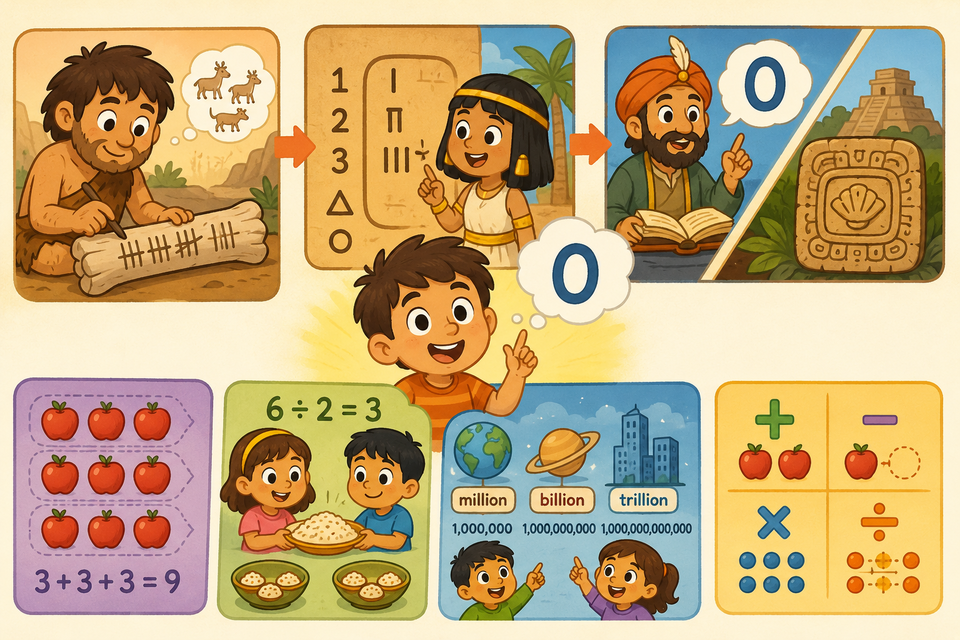
Different cultures invented symbols for amounts. The idea of zero as a number took time: Indian mathematicians such as Brahmagupta (7th century CE) wrote rules for arithmetic that included zero. The Maya used a shell sign for zero in their calendar. Zero let people write “none” clearly and build place-value systems later on.
Multiplication grew from repeated addition in trade and land measurement — counting equal rows of goods or fields without adding one row at a time forever.
Division appears in sharing problems as old as fair trade: split grain, land, or money into equal parts. Large-number names (million, billion) expanded as empires, astronomy, and finance needed to record bigger totals than everyday counting.
Past ten: tens and hundreds
You can count higher than ten on your fingers — people use place value. Ten single dots can be thought of as one group of ten. Ten groups of ten make one hundred.
- 1 one
- 1 ten
- 1 hundred
The number 47 means 4 tens and 7 ones — forty-seven dots, without drawing every dot one by one.
Big numbers in real life
The world is huge. Counting every grain of sand on a beach one by one would take forever, so we use big number words to talk about amounts we cannot easily picture dot by dot. They matter because governments, scientists, and shops all work with large totals.
| Word | How we write it | Why it matters |
|---|---|---|
| hundred | 100 | About how many people fit in a big sports field; pages in a long novel. |
| thousand | 1,000 | Steps you might walk in a long hike; students in a large school district. |
| million | 1,000,000 | People in a large city; dollars in a national budget line item. |
| billion | 1,000,000,000 | World population is several billion; stars in our galaxy are hundreds of billions. |
Each big word is one thousand times the word before (ten hundreds make a thousand; one thousand thousands make a million). We bundle in tens and thousands so we can compare and add without losing track.
- Money — prices and taxes use thousands and millions.
- Distance — kilometres between cities add up to thousands.
- Time — minutes in a year are in the hundreds of thousands.
- Nature — insects in a forest, cells in your body — counts go huge fast.
Try it yourself
Use the four demos below to practise what you read: count objects one by one, add groups together, build a multiplication array, and share dots equally. Then explore how big a number is — from one dot up to a billion.
Derivation
Why addition combines groups
Suppose the first group has \(a\) objects and the second has \(b\) objects, with no overlap. If you put them in one pile and count from the start, you say \(a\) number words for the first group, then continue with \(b\) more words. The last word is the total \(a + b\). That is why \(3 + 4 = 7\): three objects, then four more, gives seven in all.
Multiplication as repeated addition
If there are \(r\) equal rows and each row has \(c\) dots, you can add \(c + c + \cdots + c\) (\(r\) times) to get the total. Writing \(r \times c\) saves repeating the same addition. For example, \(4 \times 3 = 3 + 3 + 3 + 3 = 12\).
Division as fair sharing
If \(T\) dots are split into \(g\) equal piles with nothing left over, each pile has \(T \div g\) dots. That is the same as asking: what number times \(g\) gives \(T\)? So \(T \div g = q\) when \(g \times q = T\). Example: \(12 \div 4 = 3\) because \(4 \times 3 = 12\).
Place value and big numbers
In base ten, each column is worth ten times the column to its right. So \(47 = 4 \times 10 + 7\). Keep bundling: ten tens make one hundred, ten hundreds make one thousand, and each “thousand step” is one thousand times the step before — ten hundreds make \(1{,}000\), and one thousand thousands make \(1{,}000{,}000\). That is why we group digits in threes when writing millions and billions.
Checkpoints
Pause and answer in your head or with a partner before moving on.
Checkpoint
Show the number \(7\) on your fingers. What digit symbol matches seven?
Checkpoint
Which is greater: \(5\) or \(9\)? How do you know?
Checkpoint
Is \(2 + 2 + 2\) the same total as \(3 \times 2\)? Explain with a picture of dots.
Checkpoint
What comes next in the pattern \(2, 4, 6, 8, \ldots\)?
Checkpoint
Share 15 dots into 3 equal piles. How many in each pile? What if you try 4 piles?
Checkpoint
Which is bigger: 1 million or 1 thousand? How do you know?
Real-life applications
- Sharing snacks — \(6\) biscuits shared among \(3\) friends is \(6 \div 3 = 2\) each; check with \(3 \times 2 = 6\).
- Rows of chairs — a room with \(4\) rows of \(5\) chairs has \(4 \times 5 = 20\) seats.
- Egg cartons — two rows of \(5\) cups hold \(2 \times 5 = 10\) eggs.
- Counting steps — climbing \(8\) steps then \(2\) more is \(8 + 2 = 10\) steps.
- Population — countries and cities are counted in millions or billions.
- Packaging — eggs in cartons (\(2 \times 5\)) and sweets split among friends (\(12 \div 4\)).
Question bank
Easy
How many fingers on one hand?
Answer: \(5\).
What digit means “none”?
Answer: \(0\) (zero).
Compute \(2 + 5\).
Answer: \(7\).
Steps: Two objects plus five more gives seven.
Intermediate
Compute \(6 + 4\).
Answer: \(10\).
Compute \(3 \times 4\).
Answer: \(12\).
Steps: \(4 + 4 + 4 = 12\), or four rows of three dots.
Which is larger: \(8\) or \(6\)?
Answer: \(8\) is larger.
Difficult
Compute \(5 + 3 + 2\).
Answer: \(10\).
Steps: \(5 + 3 = 8\), then \(8 + 2 = 10\).
A tray has \(3\) rows of \(3\) muffins. How many muffins?
Answer: \(9\).
Steps: \(3 \times 3 = 9\).
Hardcore
Without counting one by one: if \(7 + 3 = 10\), what is \(3 + 7\)? Why?
Answer: \(10\).
Explanation: Addition of whole numbers can be done in either order (commutative property).
Show \(5 \times 2\) as both repeated addition and as a dot rectangle.
Answer: \(10\).
Steps: \(2 + 2 + 2 + 2 + 2 = 10\); five rows of two dots (or two columns of five).
Share \(12\) dots equally among \(4\) piles. How many per pile?
Answer: \(3\) per pile.
Steps: \(12 \div 4 = 3\) because \(4 \times 3 = 12\).
How many zeros are in one million written in digits?
Answer: Six zeros: 1,000,000.
References
- Ifrah, Georges — The Universal History of Numbers (origins of counting and zero).
- Crossley & Henry — early Indian arithmetic including zero.
Last modified: