Number & Algebra
Basic math notation
Learn the names and meanings of plus, minus, times, divide, equals, brackets, and other signs used in number sentences.
In the last chapter you met number sentences — short lines that use digits and special marks, like 3 + 4 = 7. This chapter is a guide to those marks: what each one is called, how to say it out loud, and what it tells you to do. You do not need to be fast at arithmetic yet; you only need to read the symbols like words on a sign.
History
People counted with fingers and words long before they agreed on one way to write math. Ancient Egyptians and Babylonians used pictures and marks for amounts. Over centuries, different countries used different symbols for the same ideas.
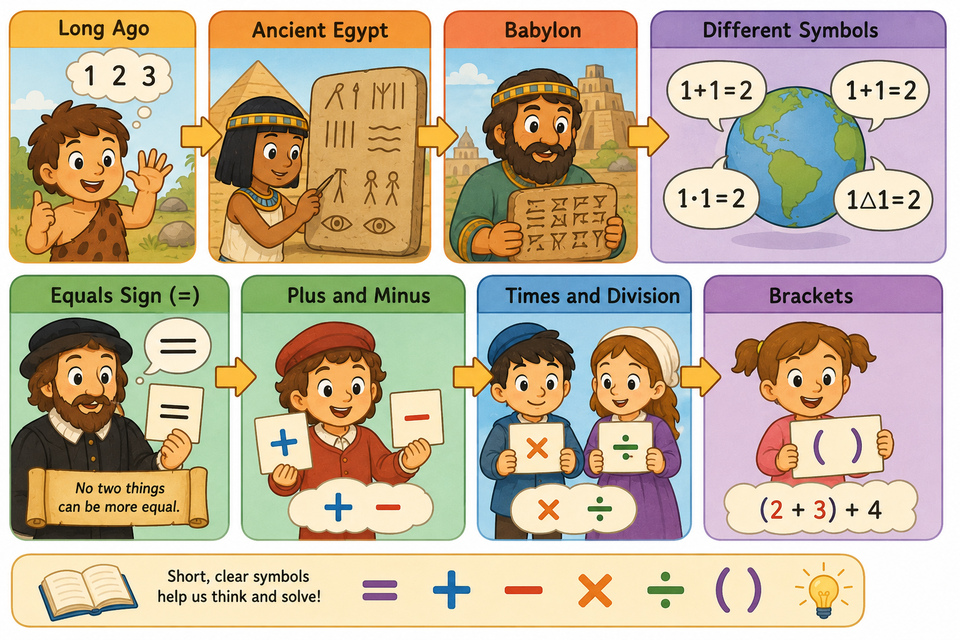
The equals sign (=) was popularised in the 1500s by Welsh mathematician Robert Recorde. He chose two lines because “no two things can be more equal” than parallel lines — a way to show both sides match.
The plus and minus signs (+ and −) became common in Europe around the same era, replacing longer Latin words. The times sign (×) and division sign (÷) appeared later, when printing books needed short, clear marks that fit on one line.
Brackets grew important when formulas got longer — mathematicians needed a visible rule for “which part first,” just like you do in (2 + 3) + 4.
Digits, words, and spaces
The symbols 0 through 9 are called digits. Each digit stands for a counting amount (zero through nine). When you write a bigger number, you put digits side by side with no gap: 47 means four tens and seven ones.
A full line of math often mixes words (in your head or in a story) with symbols (on paper). “Three plus four equals seven” is the same idea as 3 + 4 = 7.
| Symbol | Name | Say it like this |
|---|---|---|
| 0–9 | digits | “zero”, “one”, … “nine” |
| (space) | space between parts | pause between numbers and signs so the line is easy to read |
Plus (+)
The plus sign looks like a small cross: +. It means put together or add.
Read 3 + 4 = 7 as: “three plus four equals seven.” You are joining two groups into one total.
Remember
The plus sign is not the letter “t”. It sits between the numbers you are combining.
Minus (−)
The minus sign is a short horizontal line: − (sometimes written as a hyphen - on a keyboard). It means take away or subtract.
Read 7 − 3 = 4 as: “seven minus three equals four.” Start with seven things, remove three, and count what is left.
Minus or hyphen?
In a number sentence, the short line between numbers is a minus sign. In ordinary writing, the same shape can join words (like “well-known”) — that is a hyphen, not “take away.” Look at what is on each side: digits mean minus.
Times (×)
The times sign looks like a tilted cross or letter x: ×. It means multiply — many equal groups.
Our main example is three groups of four makes twelve. You can spell that same fact in several ways on paper:
- Plain with a cross: 3 × 4 = 12
- Plain with a middle dot: 3 · 4 = 12
- Plain like a keyboard: 3 * 4 = 12
- Plain as repeated adding: 4 + 4 + 4 = 12 (three fours)
- Typeset math: \(3 \times 4 = 12\) and \(3 \cdot 4 = 12\) — same story, neater symbols.
Read any of the lines above as: “three times four equals twelve,” or “three groups of four.”
Divide (÷)
The division sign is a dot with a line: ÷. It means split into equal groups or share fairly.
Take twelve shared into four equal piles; each pile has three. Again, the same fact can look different on the page:
- Plain with obelus: 12 ÷ 4 = 3
- Plain with a slash (like a fraction lying down): 12/4 = 3
- Typeset with a fraction bar: \(\dfrac{12}{4} = 3\) — top number “twelve,” bottom “four,” whole value “three.”
Read 12 ÷ 4 = 3 or 12/4 = 3 as: “twelve divided by four equals three.” Twelve dots shared into four equal piles give three in each pile.
A slash between two numbers is a quick way to write division or a fraction in one line: 1/2 is “one half,” and 12/4 is the same sharing story as twelve divided by four. In typeset math the numbers can sit one above the other: \(\tfrac{1}{2}\) (one half) and \(\dfrac{12}{4} = 3\) (twelve over four equals three).
Equals (=)
The equals sign is two parallel lines: =. It means is the same amount as on both sides.
Read a full sentence from left to right. In 5 + 2 = 7, the left side (five plus two) has the same total as the right side (seven). The equals sign is the bridge between them.
One sentence
Treat the whole line as one idea: “five plus two equals seven.” Do not stop reading at the plus sign — finish at the number after the equals sign.
Brackets ( )
Round brackets — also called parentheses — wrap part of a sentence: ( and ). They mean: do this group first, then use the result with the rest of the line.
In (2 + 3) + 4, add two and three inside the brackets to get five, then add four to get nine. Without brackets, 2 + 3 + 4 still totals nine, but brackets help when the order would be unclear.
Quick reference: the main four operations
| Symbol | Name | Meaning | Example |
|---|---|---|---|
| + | plus | put together | 3 + 4 = 7 |
| − | minus | take away | 7 − 3 = 4 |
| × | times | equal groups | 3 × 4 = 12 |
| ÷ | divided by | fair shares | 12 ÷ 4 = 3 |
| = | equals | same amount both sides | 5 + 2 = 7 |
| ( ) | brackets | this part first | (2 + 3) + 4 = 9 |
Less than and greater than (< >)
Sometimes we compare two amounts without adding or subtracting. Think of < and > as a hungry mouth: the open side points at the bigger number — it “wants” the larger pile.
- < means less than — the mouth opens toward the bigger number on the right.
- > means greater than — the mouth opens toward the bigger number on the left.
More examples
Read each line like a short sentence. The symbol tells you which side is bigger:
- 3 < 7 — “three is less than seven.”
- 9 > 5 — “nine is greater than five.”
- 2 < 6 — “two is less than six.”
- 8 > 3 — “eight is greater than three.”
- 5 < 5 is not true — five is the same as five, not less.
- 4 < 4 is also false — use = when both sides match.
The same idea works either way: 7 > 4 and 4 < 7 both say that seven is the bigger amount.
A longer compare line
You can chain comparisons when several numbers line up from biggest to smallest (or the other way around). Read it in order, one piece at a time:
9 > 7 > 4 > 1 — “nine is greater than seven, greater than four, greater than one.” Each number is bigger than the one to its right.
In words: nine is greater than seven; seven is greater than four; four is greater than one. The whole chain means nine wins and one is smallest.
- 9
- 7
- 4
- 1
You can flip the story for “smallest first”: 1 < 4 < 7 < 9 — “one is less than four, less than seven, less than nine.” Same order, different mouths.
Or the same amount
You may also see ≤ (less than or equal) and ≥ (greater than or equal). The extra line means “or the same amount,” like 5 ≤ 5.
Comma and decimal point
In big numbers like 1,000, a comma groups digits in threes so the number is easier to read — one thousand, not “one zero zero zero” as separate ideas.
A decimal point . is a tiny dot that acts like a fence in a number. Everything on the left counts whole things you can line up (1, 2, 3, …). Everything on the right tells a piece of one more thing — not another full thing.
Take 3.5. Read it as “three and a half”: three full ones, plus half of the next one. The digit 5 after the point does not mean “five more marbles” — it names how much of the next whole you have filled in.
35 three and a half
In a shop, 3.50 often means three dollars and fifty cents: dollars are whole steps on the left, cents are small pieces on the right. You will learn more about decimals later; for now, remember the point splits “how many wholes” from “how much of the next one.”
Fractions (½ and 1/2)
A fraction names part of a whole split into equal pieces. You might see a single character like ½, or plain text with a slash 1/2, or the same value written tall in math as \(\tfrac{1}{2}\) — all mean one part out of two equal parts.
Percent (%)
The percent sign % means out of one hundred. 50% means fifty out of every hundred — half of the whole. If a test has 100 points and you score 80, you might say you got 80%.
And so on (…) and about (≈)
Three dots in a row … (an ellipsis) mean the pattern keeps going the same way: 2, 4, 6, 8, … — two, four, six, eight, and so on.
The sign ≈ means approximately or about — close but not exact. 10 ÷ 3 ≈ 3 is a rough answer; the exact value is a bit more than three.
Signs you will meet later
As you grow, books will add more symbols: a colon for ratios, small numbers above the line for powers, and pairs of letters in graphs. You do not need them yet; this chapter is enough to read everyday number sentences.
Try it yourself
Say each line out loud before you calculate. Cover the answer with your hand, then check:
- 6 + 1 = 7 — “six plus one equals seven”
- 10 − 4 = 6 — “ten minus four equals six”
- 2 × 5 = 10 — “two times five equals ten”
- 8 ÷ 2 = 4 — “eight divided by two equals four”
- (1 + 2) × 3 = 9 — brackets first: one plus two is three; three times three is nine
Derivation
Why symbols instead of only words?
Writing “three plus four equals seven” every time is long. Symbols are a shorthand: the same meaning in less space, so you can compare many sentences quickly.
What equals really says
If the left side of \(=\) counts to \(a\) and the right side counts to \(b\), then \(a = b\) means both sides name the same number. If they were different, the sentence would be false — like claiming \(3 + 4 = 8\) when seven dots are the true total.
Why brackets change the order
Without a rule, \(2 + 3 \times 4\) could be read in two ways. Brackets fix one group: \((2 + 3) \times 4 = 5 \times 4 = 20\). Later you will learn more order rules; for now, brackets always mean “work inside first.”
Checkpoints
Pause and answer in your head or with a partner.
Checkpoint
What is the name of the sign in \(7 - 3 = 4\)? What does it tell you to do?
Checkpoint
Say out loud: \(4 \times 2 = 8\). Which word goes with \(\times\)?
Checkpoint
In \((5 + 1) + 2\), which part do you work out first? What is the final total?
Checkpoint
Is \(6 > 2\) true? What does the open side of \(>\) point toward?
Checkpoint
What does \(50\%\) mean in words (“out of …”)?
Real-life applications
- Recipes — “add 2 cups flour + 1 cup sugar” is a plus sentence in the kitchen.
- Scores — “Team A: 12, Team B: 8” uses comparison; 12 > 8 means A scored more.
- Sharing — “12 sweets ÷ 4 children” is fair division at a party.
- Shopping — prices like $3.50 use a decimal point between dollars and cents.
- Sales — “25% off” uses percent out of one hundred.
- Patterns — “2, 4, 6, …” on a worksheet uses ellipsis for “keep going.”
Question bank
Easy
What is the plus sign?
Answer: A cross-shaped mark + that means add or put together.
How do you say \(5 = 5\) out loud?
Answer: “Five equals five.”
Which symbol means “take away”?
Answer: Minus: − (or - on a keyboard).
Intermediate
Say \(9 \div 3 = 3\) in words.
Answer: “Nine divided by three equals three.”
What does \(\times\) mean in \(4 \times 2\)?
Answer: Multiply — four groups of two (or two groups of four), total eight.
Compute \((3 + 2) + 4\).
Answer: \(9\).
Steps: Inside brackets: \(3 + 2 = 5\). Then \(5 + 4 = 9\).
Is \(4 < 9\) true or false?
Answer: True — four is less than nine.
Difficult
Which is bigger: \(7\) or \(5\)? Write a true comparison using \(>\) or \(<\).
Answer: Seven is bigger. Examples: \(7 > 5\) or \(5 < 7\).
What does \(1/2\) mean in words?
Answer: One half — one part out of two equal parts.
A shirt costs \(20\) dollars. The tag says \(25\%\) off. What does \(25\%\) mean?
Answer: Twenty-five out of every hundred — a quarter of the price is taken off (you will learn to compute the exact dollars later).
Hardcore
Write \(2 \times 3 + 1\) in words two ways: (a) if you multiply first, (b) if you add inside brackets as \((2 \times 3) + 1\) only — are the totals the same as \(2 \times (3 + 1)\)?
Answer: \((2 \times 3) + 1 = 7\). \(2 \times (3 + 1) = 2 \times 4 = 8\). They are not the same — brackets change the result.
Explanation: Brackets show which group to do first; this is why notation matters.
Name two other symbols that can mean “multiply” besides \(\times\).
Answer: Dot \(\cdot\) and asterisk \(*\) (on keyboards/calculators).
Read \(1{,}000 + 500 = 1{,}500\) aloud. What job does the comma do in \(1{,}000\)?
Answer: “One thousand plus five hundred equals one thousand five hundred.” The comma groups digits in threes to show thousands.
References
- Recorde, Robert — early use of the equals sign in The Whetstone of Witte (1557).
- Cajori, Florian — A History of Mathematical Notations (origins of +, −, ×, ÷).
- National Council of Teachers of Mathematics — developing operation sense and notation in elementary grades.
Last modified: