Number & Algebra
Polynomials: expansion & factorisation
Expand products, collect like terms, and factorise expressions using common factors and identities.
An algebraic expression combines numbers, variables, and operations. A polynomial in one variable \(x\) is a sum of terms of the form \(a x^n\) where \(a\) is a constant and \(n\) is a non-negative integer. Examples: \(3x^2 - 5x + 1\), \(x^3 + 2x\), and \(7\).
Terms, coefficients, and degree
In \(5x^2 - 3x + 4\), the terms are \(5x^2\), \(-3x\), and \(4\). The coefficient of \(x^2\) is \(5\); the coefficient of \(x\) is \(-3\). The degree of the polynomial is the highest power of \(x\) — here, \(2\). Like terms have the same variable part (same power of \(x\)); only their coefficients may differ.
Adding and subtracting polynomials
Line up like terms and add or subtract their coefficients: \[ (3x^2 + 2x - 1) + (x^2 - 5x + 4) = 4x^2 - 3x + 3. \] When subtracting, distribute the minus sign to every term in the bracket: \[ \begin{aligned} (2x^2 + x) - (x^2 - 3x + 2) &= 2x^2 + x - x^2 + 3x - 2 \\ &= x^2 + 4x - 2 \end{aligned} \]
Expanding products
Use the distributive law: each term in the first bracket multiplies each term in the second. For two binomials, \[ (a+b)(c+d) = ac + ad + bc + bd. \] Example: \[ \begin{aligned} (x+3)(x-2) &= x^2 - 2x + 3x - 6 \\ &= x^2 + x - 6 \end{aligned} \]
A binomial times a trinomial works the same way — multiply each of the two terms by each of the three: \[ \begin{aligned} (x+1)(x^2 - x + 2) &= x^3 - x^2 + 2x + x^2 - x + 2 \\ &= x^3 + x + 2 \end{aligned} \]
Collecting like terms
After expanding, combine like terms so the answer is simplified. From above, \(x^2 - 2x + 3x - 6\) becomes \(x^2 + x - 6\). Constants, \(x\)-terms, and \(x^2\)-terms are collected separately.
Factorising
Factorisation is the reverse of expansion: write an expression as a product of simpler factors. Choose a method by inspecting the shape of the expression:
| Situation | Method |
|---|---|
| Every term shares a common factor | Highest common factor (HCF) |
| Four terms, pairs share factors | Grouping |
| Matches \(a^2-b^2\) or \((a\pm b)^2\) | Standard identities |
| Quadratic in \(x\): \(ax^2+bx+c\) | Two-number search or ac-method |
Highest common factor
Factor out the largest factor common to every term: \[ 6x^2 + 9x = 3x(2x + 3), \qquad 4x^3 - 8x^2 = 4x^2(x - 2). \] Always check whether the bracket can be factorised further.
Factorising by grouping
With four terms, split into two pairs and factor each pair: \[ \begin{aligned} ax + ay + bx + by &= a(x+y) + b(x+y) \\ &= (a+b)(x+y) \end{aligned} \] Example: \[ \begin{aligned} 2x^2 + 6x - x - 3 &= 2x(x+3) - 1(x+3) \\ &= (2x-1)(x+3) \end{aligned} \]
Standard identities
Identities
\[ a^2 - b^2 = (a+b)(a-b) \] \[ (a+b)^2 = a^2 + 2ab + b^2 \] \[ (a-b)^2 = a^2 - 2ab + b^2 \]
Recognising these forms speeds up factorisation. For example, \(x^2 - 9 = (x+3)(x-3)\) and \(x^2 + 6x + 9 = (x+3)^2\).
Quadratic trinomials
To factorise a monic quadratic \(x^2 + bx + c\), find two numbers that multiply to \(c\) and add to \(b\): \[ x^2 + 5x + 6 = (x+2)(x+3). \] Here \(2\times 3 = 6\) and \(2+3 = 5\).
For a non-monic quadratic \(ax^2 + bx + c\) with \(a \neq 1\), use the ac-method: find two numbers that multiply to \(ac\) and add to \(b\), split the middle term, then factor by grouping: \[ \begin{aligned} 2x^2 + 7x + 3 &= 2x^2 + 6x + x + 3 \\ &= 2x(x+3) + 1(x+3) \\ &= (2x+1)(x+3) \end{aligned} \]
This chapter stops at factorising expressions. Solving equations of the form \(ax^2+bx+c=0\) is covered in the chapter on quadratic equations.
Try it yourself
Use the area model to see how \((a+b)(c+d)\) splits into four partial products. Then practise choosing a factorisation method and checking your factors in the explorer below.
History
Long before modern symbols, people solved problems that required multiplying lengths and collecting areas — the same ideas behind expanding and factorising. Babylonian scribes (around 1800 BCE) recorded rectangle problems on clay tablets: given area and side relationships, find unknown lengths. Their recipes are early cousins of “expand, then simplify.”
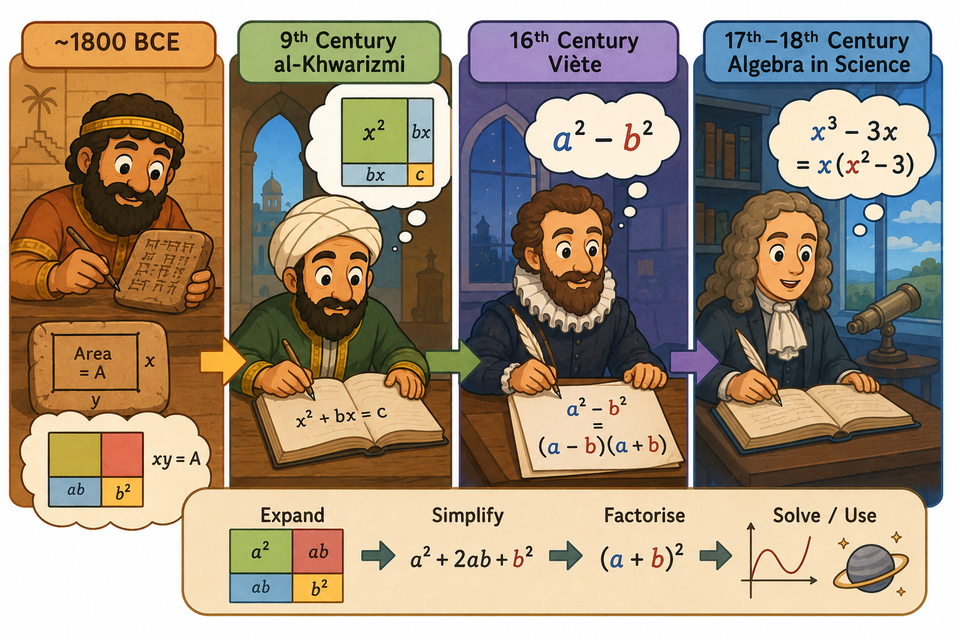
In the 9th century, al-Khwarizmi organised methods for equations and products in Arabic texts that later spread to Europe. Renaissance mathematicians such as Viète introduced letters for unknowns and constants, making it easier to see patterns like \(a^2 - b^2\). By the 17th–18th centuries, polynomial algebra was central to calculus and science; factorisation became a routine step before solving equations or simplifying formulas.
Derivation
Area proof of \((a+b)(c+d)\)
Draw a rectangle with width \(a+b\) and height \(c+d\). The total area is \((a+b)(c+d)\). Split the rectangle into four smaller rectangles with areas \(ac\), \(ad\), \(bc\), and \(bd\). The sum of partial areas equals the whole: \[ (a+b)(c+d) = ac + ad + bc + bd. \] This is the distributive law in two dimensions — the same picture as in the area-model widget above.
Deriving standard identities
Set \(c = a\) and \(d = b\) in the area formula for a square of side \(a+b\): \[ \begin{aligned} (a+b)^2 &= a^2 + ab + ab + b^2 \\ &= a^2 + 2ab + b^2 \end{aligned} \] For a square of side \(a-b\) (with \(a > b\)), remove a strip of width \(b\) from a square of side \(a\); the remaining L-shape rearranges to show \[ (a-b)^2 = a^2 - 2ab + b^2. \] Difference of squares: a large square of side \(a\) minus a small square of side \(b\) leaves two congruent rectangles, which rearrange to a rectangle of dimensions \((a+b)\) by \((a-b)\): \[ a^2 - b^2 = (a+b)(a-b). \]
Grouping walkthrough
Factorise \(3x^2 + 12x - 2x - 8\).
- Group: \((3x^2 + 12x) + (-2x - 8)\).
- Factor each pair: \(3x(x+4) - 2(x+4)\).
- Common bracket \((x+4)\): \((3x-2)(x+4)\).
Checkpoints
Pause and reason before continuing. Discuss with a partner or write your work in a notebook.
Checkpoint
In \(4x^3 - 2x^2 + 5\), what is the degree? Which terms are like terms with \(4x^3\)?
Checkpoint
Expand \((2x-1)(x+4)\) without skipping steps. How many terms do you get before collecting?
Checkpoint
How would you factorise \(x^2 - 16\)? Which identity applies?
Checkpoint
Expand \(x(x+1) - (x+1)\). What common factor appears? What is the factorised form?
Applications
Geometry: area and perimeter
A rectangle has sides \((x+3)\) cm and \((2x-1)\) cm. Its area is \[ (x+3)(2x-1) = 2x^2 + 5x - 3 \quad\text{cm}^2. \] The perimeter is \[ \begin{aligned} 2\bigl((x+3)+(2x-1)\bigr) &= 2(3x+2) \\ &= 6x+4 \end{aligned} \] cm. Expansion links algebraic descriptions of sides to measurable quantities.
Revenue and pricing
If a shop sells \(n\) items at price \((50 - 0.5n)\) dollars each, revenue is \(n(50 - 0.5n) = 50n - 0.5n^2\). Expanding a product of two linear factors often appears before finding maximum revenue (a quadratic in \(n\)).
Number patterns
Notice that \(11^2 = 121\), \(111^2 = 12321\). In general, expanding \((10^k + 10^{k-1} + \cdots + 1)^2\) explains palindromic squares — a playful link between identities and arithmetic patterns.
Question bank
Work each question, then open the solution to check your reasoning. Difficulty increases through the sets.
Easy
Expand \(3(x+2)\).
Answer: \(3x + 6\).
Steps: \(3 \cdot x + 3 \cdot 2 = 3x + 6\).
Simplify \(2x + 5x - 1\).
Answer: \(7x - 1\).
Explanation: Combine like terms \(2x + 5x = 7x\).
Factorise \(6x + 9\).
Answer: \(3(2x + 3)\).
Steps: HCF is \(3\); \(6x \div 3 = 2x\), \(9 \div 3 = 3\).
Intermediate
Expand \((x+4)(x-2)\).
Answer: \(x^2 + 2x - 8\).
Steps:
\[ \begin{aligned} x^2 - 2x + 4x - 8 &= x^2 + 2x - 8 \end{aligned} \]
Factorise \(x^2 - 9\).
Answer: \((x+3)(x-3)\).
Explanation: Difference of squares: \(x^2 - 3^2\).
Factorise \(x^2 + 6x + 9\).
Answer: \((x+3)^2\).
Explanation: Perfect square: \(3 \times 3 = 9\), \(3 + 3 = 6\).
Difficult
Factorise \(2x^2 + 6x - x - 3\) by grouping.
Answer: \((2x-1)(x+3)\).
Steps: \(2x(x+3) - 1(x+3) = (2x-1)(x+3)\).
Factorise \(2x^2 + 7x + 3\).
Answer: \((2x+1)(x+3)\).
Steps: \(ac = 6\); split \(7x = 6x + x\).
\[ \begin{aligned} 2x(x+3) + 1(x+3) &= (2x+1)(x+3) \end{aligned} \]
Hardcore
Expand and then factorise \(x(x+2) - (x+2)\).
Answer: \((x+2)(x-1)\) after factorising (expansion gives \(x^2 + x - 2\)).
Steps: Factor common \((x+2)\): \((x+2)(x-1)\). Check: \((x+2)(x-1) = x^2 + x - 2\).
A rectangle has sides \((x+3)\) cm and \((2x-1)\) cm. Find its area in expanded form.
Answer: \((2x^2 + 5x - 3)\) cm².
Calculation:
\[ \begin{aligned} (x+3)(2x-1) &= 2x^2 - x + 6x - 3 \\ &= 2x^2 + 5x - 3 \end{aligned} \]
References
- al-Khwarizmi, Al-Kitāb al-mukhtaṣar fī ḥisāb al-jabr wal-muqābala (c. 820 CE) — systematic treatment of algebra.
- HKDSE Compulsory Part curriculum — Number and Algebra strand (polynomials, expansion, factorisation).
Last modified: